Not Departing from Redruth:Cowards, Shirkers and Curs
- Nov 14, 2025
- 9 min read

November 2025
Tim Koch marks Remembrance Day with a forgotten piece of Cornish history that has recently been revived and questioned.
If you are of a certain age, there is a good chance that you will remember when the study of
history in schools was about ‘Great Men’ and when it asked ‘Great Questions’ - such as What
were the causes of the First World War?
The once highly respected but now unfashionable historian AJP Taylor (1906-1990) had the startlingly original theory that the outbreak of the First World War was a result of railway timetables:
All the European powers had built up vast armies of conscripts. The plans to mobilise in these millions rested on railways and railway companies cannot be improvised. Once started the wagons and carriages must roll remorselessly and inevitably to their predestined goal.
Taylor probably made this oversimplification to stress how the triggering of a complex web of international alliances led inevitably to war. However, it is difficult to deny that the First World War was a Railway War, trains were the only way to move the men and equipment needed for a conflict that was the culmination of the Industrial Age. Few soldiers went from recruiting office to front line without taking many train journeys departing from Redruth, Reinstädt, Rostov or any one of thousands of other such stations.

As its caption indicates, the postcard reproduced above shows army volunteers on Redruth
Railway Station on 26 September 1914, two months after the United Kingdom had declared war on Germany and its allies. They were probably on their way to Bodmin for basic training at the Duke of Cornwall’s Light Infantry (DCLI) depot.
At this point, many people thought that the war would end quickly and these young men’s biggest fear may have been that, before they finished training, the fighting would be over and all the glory would have been taken by the regular army.
One person who did foresee a long and brutal conflict was the Secretary of State for War, Lord Kitchener, who recruited a massive new all-volunteer army (‘Kitchener’s Army’ or, disparagingly, ‘Kitchener's Mob’) to boost the existing small standing army.

It is impossible not to speculate on the fate of the anonymous men on Redruth Station. How
many were still alive fours years later? I know only of one person pictured (the only one that I can identify) who definitely survived the war - Sergeant Benjamin H Nicholls.
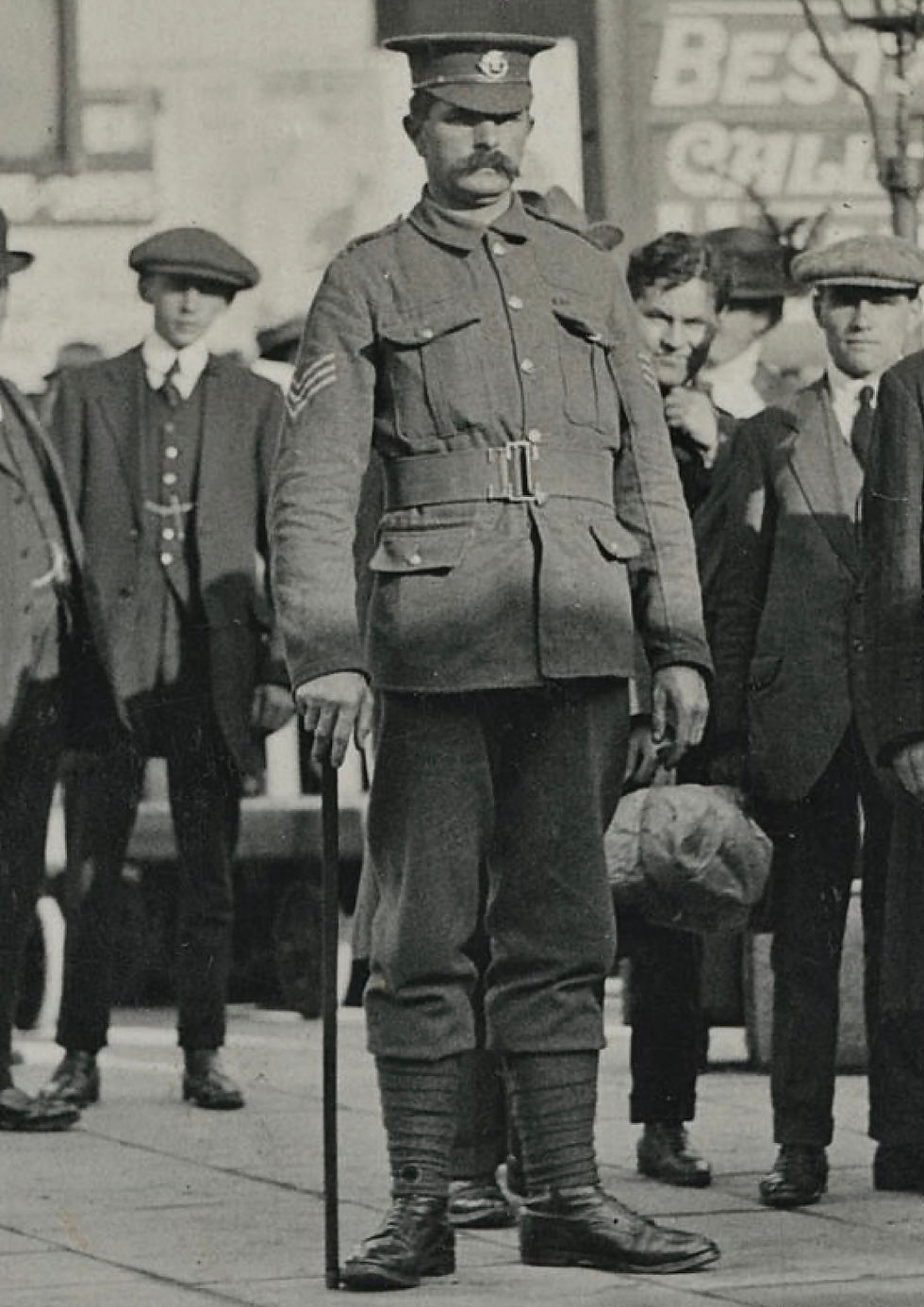
The Royal Cornwall Gazette of 21 January 1915 wrote that:
Sergt. Ben Nicholls (DCLI), who has shown considerable skill as the recruiting officer for the Mining Division, was at Redruth Railway Station on Monday to witness the departure of a number of recruits for various regiments.
This was not the first or last time that Sergeant Nicholls saw off his recruits at Redruth. For
example, The West Briton of 11 November 1915 reported Nicholls’ successes for the previous two weeks; he had recruited 51 men in the last week of October and 23 in the first week of November.

As an aside, there was one particular group of men who were common in the Redruth and
Camborne area that Sergeant Nicholls was particularly keen to recruit - though not primarily as fighting soldiers.
On 5 August 1915 The Royal Cornwall Gazette reported:
There was a large crowd at Redruth railway station on Monday evening to witness the departure for London of miners who will shortly proceed to France for tunnelling duty etc.
The Cornish miners' experience in underground mining, including their knowledge of timbering and ground conditions, was invaluable in constructing tunnels under enemy lines which were then filled with huge amounts of explosives and detonated. Some of these explosions were heard in London.
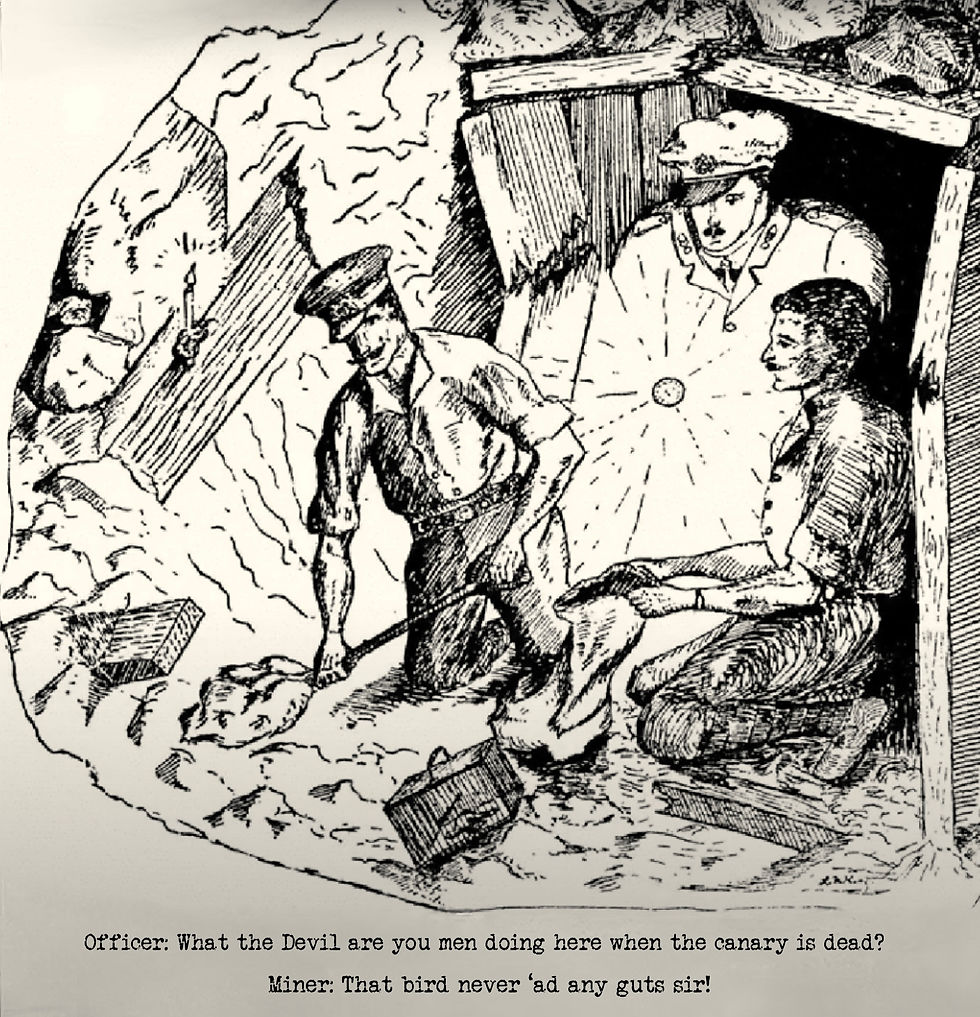
The miners were offered six shillings (30p) a day, twice what they were earning at home. Notably, in April 1915, 221 miners who had been infantrymen in the DCLI for only two months were transferred to the Royal Engineers to become the core of the Cornish dominated 251 Tunnelling Company (‘The Moles’) and very quickly found themselves in (or rather under) Loos in Northern France.

As the specifically Cornish recruiting poster reproduced above hints at, after an initial surge of enthusiastic volunteering in the early days of the war, the numbers joining up began to decline with those in Cornwall dropping more than the national average. The Royal Cornwall Gazette’s report on a recruitment meeting at St Day in early April 1915 gave an indication of how the attraction of enlistment was fading in the county just nine months into the
war:
Lieut. West commented on the backwardness of Cornishmen generally in joining the colours…Mr Peter Jennings, who presided, said that… the number of men now serving from the parish was about 70, but there were remaining at home… no less than 97 men between the ages of 18 and 29 and 77 between the ages of 30 and 38…
Sergeant Ben Nicholls… who was at the back of the room endeavouring to get some of the young men to enlist, announced that one young man with a nice moustache had stated ‘that he was not old enough to enlist’ (laughter). Another young man said he would not enlist as his mother was not worth protecting (‘shame’)…The Rev TG Gardener proposed a hearty vote of thanks to Lieut. West and his men and remarked that, although he was a preacher of the Gospel of Peace, he would hang the Kaiser…
However, just three recruits handed in their names at the end of the meeting.

Lieutenant West had also been quoted in a report in the Cornishman of 25 March 1915 about a recruitment meeting in Helston:
(Lieut. West said that) he could not understand the spirit that was abroad in Cornwall; one local man had told one of his lads that ‘We are not all fools down here to join up and fight.’
Also in the same edition of the Cornishman, Captain Roach of the DCLI had ‘An open letter to the young men of Cornwall’ in which he told them, the recruiting returns for the county of Cornwall brand you cowards, shirkers and curs.

However, perhaps Cornwall was not really so out-of-step with the rest of the United Kingdom. Recently, there has been some convincing work repudiating Cornwall’s allegedly reluctant First World War recruitment record.
In 2018, Melanie James wrote on The Great War Forum:
An enthusiastic nationwide response to the early call to arms has passed into the nation’s
collective memory… Whilst there is continuing debate as to whether such enthusiasm really was so widespread, it was reported at the time that recruitment was not high in Cornwall where there may even have been a general sense of indifference to the declaration of war. My (MA dissertation) explores the Cornish response and seeks to provide new understanding of the county’s contribution, overturning its poor reputation.
James holds that there were good reasons for ‘under recruitment’ in Cornwall but also that the official figures were unreliable and misleading:
Cornwall’s low population, resulting from decades of emigration, meant that there were relatively few men in the necessary age bracket available for voluntary military service; that agricultural work, and mining, as reserved occupations, kept many potential volunteers from enlisting…
Cornish ‘reserved occupations’ were essential for food and industrial supplies so many local men felt - and were told - they were already serving the nation by staying at work. In Cornwall, fishing and farming communities in particular relied heavily on every able-bodied man so families were reluctant to let sons leave. Thus, in some places peer pressure actually worked against recruitment. Further, recruitment drives were generally focused on cities and industrial centres. Rural Cornwall did not get the same attention until later in the war and this may have added to the feeling that the war was a distant thing.

James:
…the Navy seemed a more attractive option for those Cornishmen who did come forward, given Cornwall’s sea-faring history and sea-girt status… (It) is evident that a naval war was expected and, in that regard, it was believed Britain was well prepared. The newspapers recorded the mobilisation of Cornishmen in the Navy and Reserve in such numbers that it was feared the removal of so many men from fishing ports would have ‘a retarding effect on the fisheries.’ The Cornish felt the war was ‘a matter for the Navy,’ they were accustomed to sending their men to the Navy and Reserve in huge numbers, and felt they contributed handsomely. There was no indication of the trench warfare to come…It was estimated that men from Cornwall and Devon at one time made up two-thirds of the Royal Navy’s total manpower…
As to the official figures, James holds that:
…regardless of Cornish recruitment figures, they simply do not reflect the vast numbers which preferred to enter the navy… naval records were poorly kept (and this) means that the Cornish volunteer numbers were just not accurately reported.

On the influence of Methodism, James says:
(It) must not be overlooked that Cornwall was a Methodist stronghold… (The) Cornish had been taught by church and chapel to regard war as anti-Christian, so recruitment in 1914 was a delicate task…
However, once war was declared, there was astonishing U-turn by most Methodist churches and churchmen. Instead of proclaiming peace, they declared the war to be a fight of good against evil. The minority who could not reject a literal interpretation of ‘Thou shall not kill’ were largely abandoned by their church.
...once it became clear that the church encouraged enlistment believing the cause to be just, the collective conscience was cleared…

One statistic that is not disputed is that 6,300 of the men who left Cornwall to go to war between 1914 and 1918 did not return.
My thanks to Mike Tresidder of the Granite Kingdom blog for his input.
Tim regularly contributes to the website https://heartheboatsing.com/
Thank you Tim for such an interesting account and for all the research shining a new perspective on received ideas. Tim wrote this piece to coincide with Remembrance Day. So it is only fitting that I mention Cora Ball who is the only woman on the war memorial in Truro. Born in 1896 she joined the Women's Auxiliary Army Corps (WAACs) and served in France. She died in Calais in November 1918, two days after the Armistice, of Spanish Flu. My grandmother, Mabel Coole, also served in the WAACs.
Last week I went to see The Choral at the Newlyn Filmhouse Putting on a performance of Elgar's Dream of Gerontius with the background of young men leaving and returning from WW1. Very moving and beautiful. Leaves you feeling ' do we never learn?'
AH



Comments