Redruth to Al Khobar, Eastern Province, Saudi Arabia.
- Feb 13
- 5 min read

February 2026
Alex Bywaters shares his account of travelling to work in Saudi Arabia as a young man and the impact it had on his later life.
It was early in March 1977, when I boarded the Redruth to Paddington train as the first part of a journey to start my new job overseas, in Saudi Arabia. I was 20 years old and had no idea what to expect other than it was going to be far warmer than Helston and I wouldn’t be allowed to return for at least 6 months.
Travel had always been part of my family’s life, albeit to Europe where my mother’s family lived and where we spent most summer holidays, but this was different. On arriving at Paddington, I made my way to Heathrow airport to catch a Saudia Airlines flight to Dhahran Airport – later to become relatively (in)famous as a US Airbase in the first Gulf War. In my naivety, thought that I might be able to have my last taste of alcohol on board the flight. However, this was not to be. My first experience of Arabian culture! It wasn’t until I got off the aeroplane and came to terms with the feeling of having enormous hot air fans blown at me, that I realised that I wasn’t alone in my quest to find the ’meet and greet’ person who would welcome us and take us to our temporary abode. There were two of us in the same situation, which shared the uncertainty a little.
My new job was as part of a ‘Setting Out & Land Surveying’ team of three employed by an Arabian firm engaged mainly on petro-chemical projects for the Arabian American Oil Company.
The political situation at the time was complex. There was civil war in the Lebanon, Israel was not recognised by any Arab state; at least not until November 1977 when Egypt’s President visited Israel to the disgust of the other Arab states. This resulted in Egypt being suspended from the Arab League. Yasser Arafat was head of the Palestine Liberation Organisation and Jimmy Carter was President of the USA. No-one was allowed to enter Arab states (including Saudi Arabia) if they had an Israeli stamp in their passport. Saudi Arabia was being ’courted’ big time by the USA in the form of very cheap imported vehicles, technology and military support.
Saudi was ruled by King Khaled, women were second class citizens who were unable to go anywhere without a male chaperone, physical work was done by Yemenis, Palestinians, Pakistanis, Somalis and Turks with supervisory roles done, mainly, by Lebanese. Many businesses were run by Lebanese but they had to have Saudi backers or partners.
The Americans tended to be very happy with this status quo and didn’t see the need to interact, communicate or give instructions in anything other than English. They tended to travel from their air-conditioned jeeps to air-conditioned offices and live in air-conditioned accommodation.
My living arrangements were wide-ranging. At times I was resident in an American Camp which was a self-contained gated ‘township’. At others, I lived in an apartment block in Al Khobar with armed police at the entrance during Christmas to discourage non Arabs from wandering about under the influence of alcohol. Then I stayed in a villa in the town of Hofuf built largely of mud (it was, supposedly, mentioned in the bible). Sometimes we were in a tent in the desert for several months.
This variety of living styles led to quite different experiences; the American camps were ‘little America’, with pool tables, cinemas, burgers and American supermarkets where one could purchase ingredients to brew beer. Some had bars. The Americans supplied various personnel with a still and the opportunity and ingredients to make alcohol, known as Sidiki. This was, apparently, sold to Arabs, as well as non-Arabs, although if caught, the punishment was prison and then deportation.
The villas, flats and tents gave me the opportunity to integrate, once I had learnt a smattering of Arabic, by way of shopping and eating in cafes. A period of stability of accommodation and projects meant that I had a room in a flat and access to the vital ingredients to make beer. This helped make life a little easier – as long as one kept oneself to oneself and stayed in. The armed guards encouraged this!
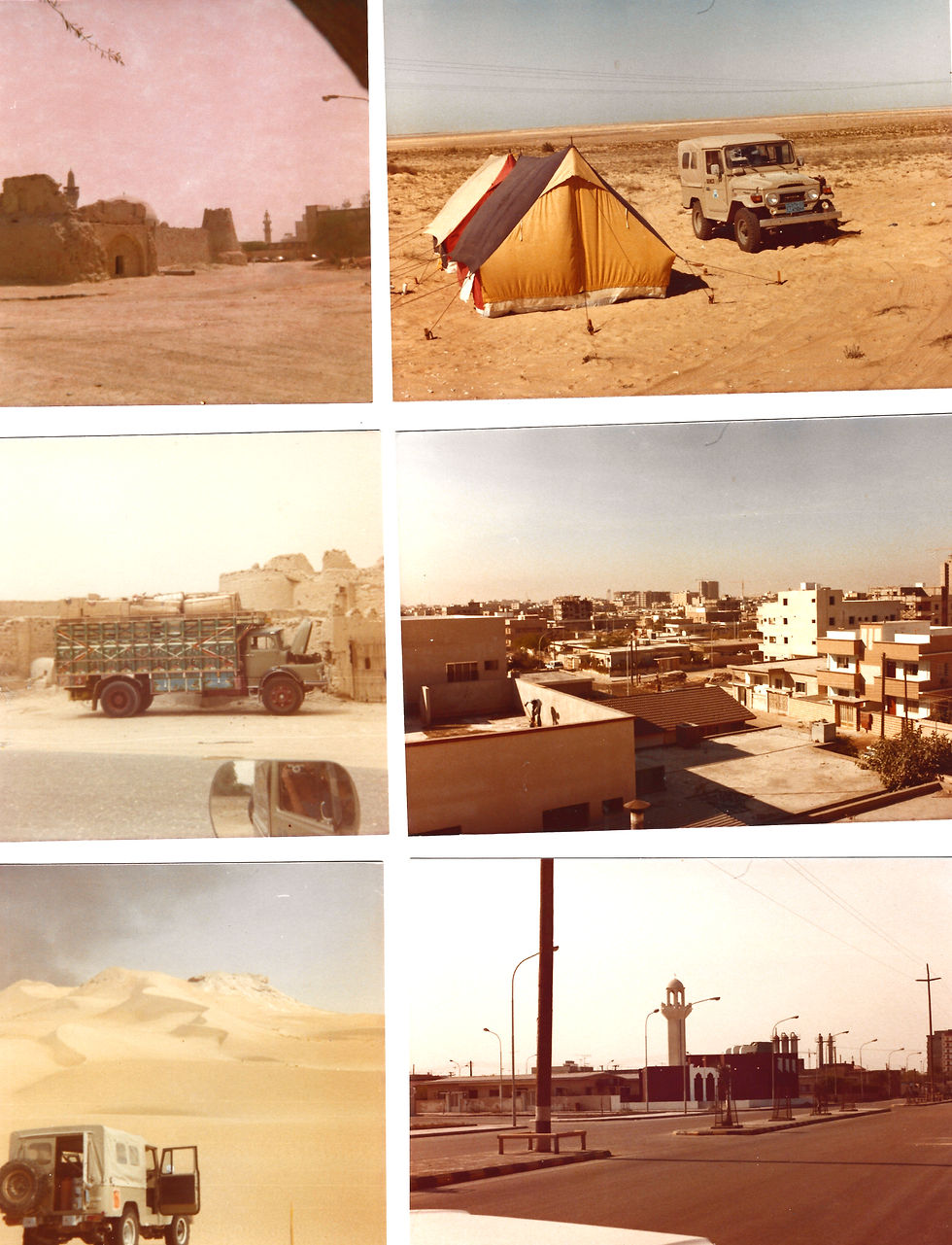
The humidity on the coast was exceedingly high and uncomfortable. It was much drier in the desert but hotter, during the summer months. The hottest I encountered was 55 degrees. However, one needed jackets during the winter.
The more I managed to integrate, be it from a cultural or work perspective, the more I realised that the vast majority of people were at the mercy of the elite in terms of wealth and employment. I found the Arab world (such as this small sample was) exceedingly fatalistic, even to the trucks that sped up and down the highways which showed no regard for safety, as they had “Allah is with me” painted on the front and “if Allah wills it” on the reverse! Sadly, by the number of wrecks that littered the highway verges, the drivers’ expectations were optimistic.

Political discussions were rare. My Arabic was never going to be good enough to converse at that level but quite a number of Lebanese that I came into contact with, did speak reasonably good English and the civil war and Palestine were always top of the agenda. There was a lot of support for Palestine especially in the provinces. In Hofuf, our main supermarket, for want of a better word, was run by and existed to aid the Palestine Liberation Organisation – a version of a Co-Op I guess.
My two-year contract was brought to a slightly premature end when I returned to England to attend my cousin’s wedding late in 1978. It was an experience that has stayed with me all my life. As has a profound sympathy and support for the Palestinian people. Never more so than at present, with the current ongoing genocide that most of the world has seen fit to ignore.
A somewhat tenuous link to Redruth station, but it was instrumental in propelling me to the career in Civil Engineering that I hadn’t foreseen and to instill in me empathy and caring about others for which I am very grateful. Over the years, music has played a great part in my life, and I have been fortunate to be able to organise and play in a New Year’s Eve Ceilidh in my adopted town of Holmfirth, which raises funds for our local foodbanks and Medical Aid for Palestinians. Last year was no exception.
Thank you so much Alex (or Bimbo as your 'old' friends know you!) for such an interesting account. I wonder if it possible to go all the way by train, if time were no constraint.
Regarding fatalism, I lived in Cairo a few years later and vividly remember this conversation with a bus driver:
Me: Excuse me. When does the bus get to Alexandria?
He: I don't know.
Raised eyebrows on my part and desperate effort to rephrase my shaky Arabic.
Me: What time do you expect to get there?
He: In sha Allah (God willing), 3 o'clock ...
I am very grateful to friends and readers for sharing their travels and research. I forgot to mention last time that Tim's article was particularly pertinent as this is The National Year of Reading encouraging the joy of reading for all ages especially with the very young. For more information locally about campaigns and getting involved: https://literacytrust.org.uk/communities/cornwall/


Comments