Redruth to Luxembourg from Brussels
- May 30, 2025
- 7 min read

April 2025
The train from Brussels to Luxembourg was a double decker with lots of space to spread out. It was also remarkably reasonable at ten euros each. We travelled through the green farmlands of Wallonia and then the extensive forest of the Ardennes. This was the site of the final German offensive in WW2 in 1944 against American forces in the main, known as the Battle of Bulge. It was particularly fierce, made even harder by the harsh winter weather.
We, however, arrived in Luxembourg city to bright blue skies and sunshine. It turned out that our accommodation was only five minutes from the train station in the Rue de Strasbourg (fitting as that was to be our next destination). Unfortunately, we arrived during major roadwork upheavals for gas or water pipes. As it was a Sunday evening all was quiet but the street was a bomb site with deep holes and trenches as well as heavy machinery resting in wait for the next assault. This was to start with a vengeance at 7am the next morning. Not a battle scene by any stretch of the imagination, those are all too real at the moment, and it will make for better services in the long run but it was disappointing as this was not the accommodation we had booked. The next couple of days were inevitably noisy and dusty on the 'home' front. The locals seemed to take it in their stride and still positioned their chairs outside their preferred café on the edge of a crater. This was a lively, multi cultural area. That evening we walked out along a Boulevard towards the city centre, over the bridge with astonishing views into the gorge. We came upon a family festival where we watched a strongman lift another man sitting on a chair ... with his teeth. Then we had our first beer in the Place des Armes. Outdoor bars, beer and sunshine. What's not to like?
So why had we decided to visit Luxembourg. Must admit, the main reason being that I knew nothing about it. When I asked around people admitted they had only stopped to get petrol on the way to somewhere else. Secondly, I learnt that all public transport in the country is free. That had to be seen to be believed and admired. Also it is a wealthy European country that just quietly gets on doing what it does. It is also a multi-lingual place: 98% speak French, 80% English, and 78% German. Luxembourgish is used by 77% of the population, there is also a substantial minority that speak Portuguese and where we were staying there were African languages too. So we had just two days to get a superficial feel for the place; time to get the walking shoes on and jump on those trams.


Gliding trams Rue de Strasbourg View from the Ramparts
Luxembourg is a classic medieval fortified city which was built to defend the people who lived inside and provide a portal for those outside to trade and hence create an opportunity for tariffs on goods - sounds topical. These fortifications were strengthened in the seventeenth century by the French master fortifier Sebastien le Prestre, Marquis de Vauban. We had encountered his towering brick stockades in Belle Ile last summer. Vauban must have been incredibly busy during the reign of Louis XIV as his name and his building work crop up all over. When Luxembourg gained independence in 1867, the aristocrats decided to create a hereditary Grand Duke to rule the land with the notion that this would ensure a sense of nationhood. The incumbent is Grand Duke Henri who will be abdicating this year in favour of his son Guillaume.
The tourist office supplied us with a map for a walk of 'a thousand years of history' which was mainly an excuse for a fabulous walk across bridges and ramparts, through blossoming orchards, along the river and into less commercial parts of the city with some stunning aspects and views. We could also have chosen the 'Vauban walk'.





The Legend of Melusina- a myth that has been owned by Luxembourg but also occurs in other parts of central Europe.
Count Siegfried was walking along the banks of the Alzette one day when he met a most beautiful princess. She was the nymph of the Alzette, called Melusina who charmed the valley. Siegfried, of course, fell madly in love with her and asked her to marry him. She accepted but on one condition that every Saturday she was to be left to herself and he was to make no attempt to find out what she was doing. They lived happily for many years and raised a family together. But, one Saturday, Siegfried was passing her room when he heard a great splashing noise and he peeped through the keyhole to discover Melusina sloshing about in a large pool, transformed into a mermaid. As soon as her true nature was revealed, she was swallowed up by the earth and sealed into a rock known as the Bock from which she only reappears every seven years ...
Standing on the tram, not knowing where we would land, we spotted the Villa Vauban which houses the city's major art collection. So we jumped off and encountered the lively Nikki de Saint Phalle sculpture in the beautiful garden of the gallery. We had encountered her work in Nice a couple of years ago; her colourful sculptures bring such joy to a space. Am enjoying these travel connections.
The city has invested in a stunning gallery to house its permanent and temporary displays. Tony as a trained designer was bowled over by the quality of the finishes. In awe of the door frames, internal and external views, stairways. All created with great flair and attention to detail. There is also a fun use of AI in the entrance room where some of the paintings have been made to move and grow. The soldier featured below is actually a tiny painting by J.L.E Meissonier. It certainly makes you seek out the original.


Prince William of the Netherlands served under Wellington in the Peninsular Wars and The Battle of Waterloo. Eager to show his courage and leadership, he became reckless and too many of his men were killed unnecessarily He too was wounded. Tony was very keen on the series 'Sharp' back in the nineties featuring actor Sean Bean in which it is Sharp himself who wounds William to get him off the battlefield. He was known by the English as 'slim Billy' and is the possible source of the epithet 'silly Billy'. There is a large heroic statue of him on a magnificent horse in the Place Guillaume II (see above).
When he became King William II of The Netherlands and the Grand Duke of Luxembourg, along with his queen Anna Pavlovna, sister to Tsar Nicholas 1st, he decided to build an art collection. The Tsar loaned him money to make purchases and when William died, he demanded some of the paintings as repayment. As much of the collection was being sold off, he was forced to purchase some of the paintings he had already paid for. The core of the current collection dates back to the one William built. Recently the whole original collection was brought together with exhibitions in St Petersburg, Dordrecht and Luxembourg.
As well as the more classical collection, there is also a changing exhibition space. While we were there it was showcasing the Luxembourg impressionist painter Jean Pierre Beckius, 1899-1946. I was particularly taken by his very tender portraits of his family. He was mainly known for his landscape paintings.


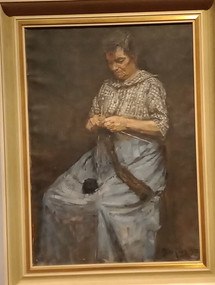


The painter, his wife and parents
Luxembourg is such an easy city to navigate, has the most beautiful public gardens behind the Villa Vauban and a splendid elevator connecting the upper and lower parts of the city (invaluable for Deliveroo cyclists). It is without doubt a wealthy place which it has invested in public spaces. I suspect a lot of the wealth is hidden behind less flamboyant facades. There are a lot of designer shops for those with the inclination and the purse, streets that are made for strolling through and are very clean. Also a great contemporary art space called the Casino which also holds an art library of books and periodicals which anyone can access, along with easy chairs for quiet reflection or perhaps forty winks ... It was a warm day! My only regret was not having time to go out into other parts of the country - another time maybe? A very happy stay.


Our journey to Strasbourg was the least pre-planned section of our journey. We had purchased our tickets the day before and been told they were open tickets and we could get on any train, change at Metz. The train we'd decided to travel on turned out to be a TGV, so we couldn't get on that and had to wait an hour or so. So went and bought a coffee and sat in the sunshine. Hardly a hardship. The train pulled into Metz where the information board was saying that our transfer train was 'supprime' (sorry don't know how to put in accents) or 'cancelled'. In fact no trains on that line until 7pm. All the staff had been directed to deal with the jostling crowd of anxious Parisians who were also being re-directed. A train had hit a car on a level crossing; we didn't discover the outcome. I fear we must have looked forlorn because a young man and a woman came over and explained another route via Nancy. So we boarded a small, local stuffy train. Armed police got on to check our papers. The policeman was very polite to us and spoke English but ours were the only papers that were in order, all the others were out of date! It was so hot in Nancy that we just sat in a café, drank Orangina and watched the world go by as we waited for our connection. Finally we arrived at Strasbourg, where my lovely friend was waiting for us and we jumped on the tram back to her house across the Rhine in Germany. And there began the next adventure ...

Still hooked on 'Slow Horses'.



Comments